In Conversation with Paul Vanstone
We recently caught up with fair exhibitor Paul Vanstone to talk about his lifelong relationship with stone, the enduring appeal of the human form, and the creative dialogue between artist and material. From discovering limestone as a student to working with marble from quarries around the world, Paul shares how each block of stone presents its own possibilities and why the element of uncertainty continues to inspire his work.
Marble is one of the oldest sculptural materials in history. What first drew you to carving stone?
I first started carving stone while studying at Central Saint Martins in the mid-1980s. Chris Haysom, whose family owned the Purbeck quarries in Dorset, handed me a block of limestone and simply said, “Carve that.”
I spent almost a year working on that single block with just one chisel and one hammer, and I became completely fascinated by the process of revealing a form from within the stone. I worked almost exclusively in limestone for the next five years before discovering a block of marble in a London stone yard. Suddenly, I realised how different materials could shape both the creative process and the finished sculpture, and that opened up a whole new world of possibilities.
Your sculptures often explore the human figure in beautifully simplified forms. What draws you to the human form?
The human presence has always made the most sense to me. I greatly admire abstract sculpture, but I’ve never been able to make it myself. Holding onto the essence of humanity within my work feels essential.
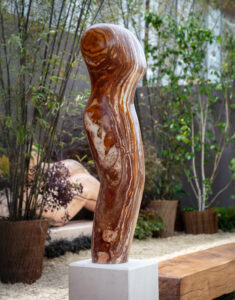
I’m fascinated by the contrasts that stone allows me to explore. Marble can have an extraordinary, almost skin-like translucency, despite being one of the hardest materials imaginable. That tension between softness and hardness is something I return to again and again. Wings, for example, have been a lifelong fascination of mine – creating something so delicate and weightless from a material that is heavy and earthbound. Every type of stone has its own unique qualities, and I enjoy using those natural characteristics to heighten the ideas I’m trying to express.
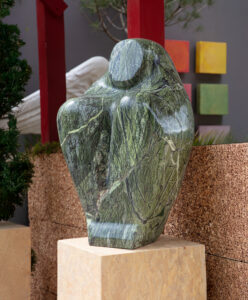
Does the stone ever influence the finished piece?
Absolutely. I often arrive at a quarry or stone yard with ideas of what I want in mind, but they usually go right out the window when I see the stones.
Choosing stone is an instinctive process that’s been shaped by years of experience. A particular vein, colour or flaw might suggest a completely different direction, and I respond to that. Every block has its own character and potential, so rather than forcing an idea onto the material, I am guided by the stone.
Stone carving has such a rich history. How does that tradition influence your work today?
When you begin carving stone, you become part of a tradition that stretches back thousands of years. Working with Carrara marble, for example, inevitably connects you with generations of sculptors who have used the same material since Roman times.
At the same time, I also work with stones that have much shorter carving histories, such as marble from Rajasthan in India. These materials have very different characteristics, so they demand different approaches. Every block requires its own decisions.
For me, half the enjoyment lies in spending time with the stone itself – reacting to it, understanding it and responding to it. It’s a deeply personal process that can’t be delegated, and there’s always an element of jeopardy in it. That’s what keeps it exciting and continues to inspire me.