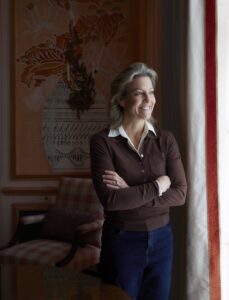
5 Questions with Henriette von Stockhausen
We recently spoke with leading interior designer Henriette von Stockhausen, Creative Director of VSP Interiors. Known for her richly layered schemes, Henriette brings a deep knowledge of antiques and architectural history to her practice. Her work is defined by a thoughtful interplay of old and new, where craftsmanship, colour and collected objects come together to create interiors of enduring character.
Antiques sit at the heart of your work – what do they bring to a scheme that contemporary pieces often cannot?
Antiques bring a sense of soul, story, and permanence that is almost impossible to replicate. They carry the marks of time – wear, patina, slight irregularities – that give a room depth and authenticity. Contemporary pieces can be beautiful, of course, but they rarely have that same quiet authority.
An antique has already lived a life and has a story to tell before it arrives in a space, and that history creates an immediate richness. It stops a room from feeling contrived and instead allows it to feel as though it has evolved naturally over time.
Do you begin a project with key pieces in mind, or do antiques emerge more organically as a scheme develops?
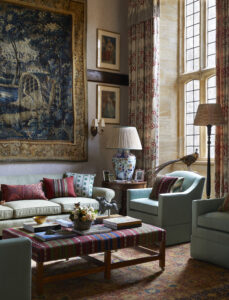
It is always a bit of both, but more often than not it’s an organic process. Occasionally, there will be a particular piece – like an antique rug with its wonderful colours and patterns, or a cabinet, textile, or painting – that quietly anchors the direction of a scheme. But generally, I prefer to let things unfold. I don’t like interiors that feel overly predetermined or forced. The most successful rooms are those that have a sense of discovery about them, where antiques are introduced gradually, almost as though they’ve always belonged there—like pieces acquired through generations of a family.
You always put a four-poster or corona bed in – you’ve said you don’t think you’ve ever done a project without one. What does a bed like that do for a room that nothing else can?
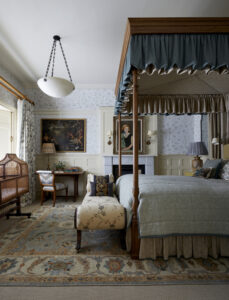
A four-poster bed creates architecture within a room – a smaller enclave or comfortable space within a space. It gives a sense of enclosure and intimacy, especially in a larger room, and introduces a vertical element that draws the eye upward. It’s not just a piece of furniture – it becomes part of the room’s structure.
There is also something deeply comforting about it; it feels protective, almost cocooning.
Aesthetically, it brings a softness and romance that is very difficult to achieve in any other way. I generally try to use a darker-coloured silk or an antique hanging on the inside to emphasise this feeling of comfort and narrative.
Do you consider yourself a collector of anything, and if so, how has that collection evolved over time?
I think I am a collector almost by instinct rather than intention. Over time, I’ve accumulated textiles, ceramics, and small objects – pieces that please me, things that have caught my eye for reasons that are often difficult to articulate.
The collection has become more edited as I’ve grown more confident in my taste. Earlier on, I was perhaps more acquisitive, but now I am far more selective. Each piece has to justify its place, either through its beauty, its usefulness, or simply the feeling it brings.
I do, however, still adore my collection of majolica and cabbage ware, which I started collecting when I was very young – they still adorn the wall in my dining room at home. Other pieces I’ve been lucky enough to live with for a time I have since sold on and used in special projects, where they’ve been given a new lease of life and can continue their story.
What’s the last thing you bought that you absolutely didn’t need but couldn’t leave behind?
I bought an antique bed hanging, which I am using on a beautiful bed tester I am creating for a client’s master bedroom. I simply couldn’t resist it – it’s the palest blue thread embroidery on the peachiest silk. It’s divine.
Generally, it’s something quite small and quietly irresistible – a piece of pottery or an antique textile. Recently, it was a rather imperfect ceramic vessel. It wasn’t grand or particularly rare, but it had the most extraordinary surface and a slight irregularity in its shape that made it completely unique, so I turned it into a beautiful lamp for myself.
Those are the things I find hardest to leave behind – the pieces that feel as though they have a personality of their own.