Often no larger than a jewellery box, tea caddies contain some of the finest craftsmanship of the eighteenth and nineteenth centuries. Look a little closer, and you’ll discover miniature masterpieces created by many of Britain’s greatest cabinetmakers. From architectural forms and exotic timbers to intricate marquetry and ingenious hidden compartments, these remarkable objects reward close inspection. Exhibitor Mark Goodger Antiques (Stand A18) talks us through three outstanding examples to see at the fair.
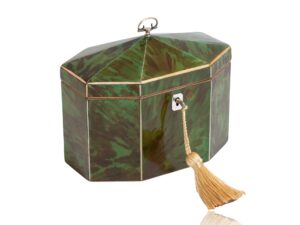
Tortoiseshell tea caddies are and have always been very desirable to collectors; in particular, the vibrant green tortoiseshell ones with their simplistic shapes can sit within a modern home and be considered a piece of art, lifting a space and elevating the piece of furniture it sits upon.
The example illustrated above is an exceptional late eighteenth-century caddy, distinguished by its rare octagonal form and tented lid—features that are highly sought after and encountered far less frequently than the more conventional shapes of the period. Circa 1790, £9,500
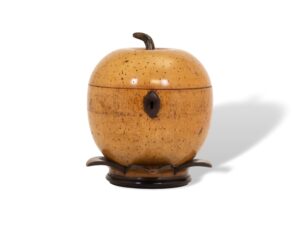
Novelty fruit-shaped tea caddies are highly collected; commonly described as English and made of Pear or Apple wood, sadly, this lovely myth is untrue, they are continental, made in Germany/ Buddpest and were sold in Spa towns as gifts. Patina and colour are everything when it comes to these caddies.
This charming
fruit-form tea caddy is only the second example we have had the pleasure of acquiring in over thirty-five years of specialising in tea caddies, underlining its exceptional rarity.
Made from sycamore, the caddy is modelled as a piece of fruit with evenly spaced dimples across its surface, complemented by a painted green stalk. It rests upon a delicately carved and painted basket of leaves, enhancing both its sculptural quality and visual appeal. While the precise fruit represented remains open to interpretation, it most closely resembles an apple nestled within a basket of leaves.
Whimsical, naturalistic tea caddies of this quality and rarity seldom appear on the market, making this a particularly desirable example for the discerning collector.
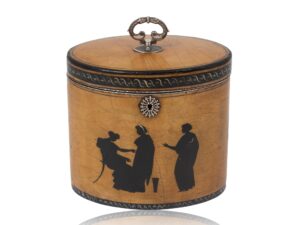
Among the highlights of this year’s collection is this exceptional
tea caddy by Henry Clay, a particularly fine example of the celebrated maker’s work. Decorated on a rich yellow ground in the Greek Revival taste, its design draws inspiration from the black-figure pottery of ancient Greece, a fashionable source of influence during the late eighteenth and early nineteenth centuries.
Henry Clay was an English maker of high quality papier-mâché goods best known for his innovative paperware and his appointment as Japanner to His Majesty.
The front and reverse are each adorned with finely executed silhouetted figural scenes in black against the warm yellow-orange ground. One panel depicts a classical composition of a youthful male figure holding a thyrsus and flowers, facing two young women carrying a fillet, situla, phiale and thyrsus. Executed in the restrained neoclassical manner for which Henry Clay is renowned, the decoration displays both elegance and refinement.
The caddy retains its ornate silver handle and is further distinguished by the finely pierced silver escutcheon in the form of a snowflake, a characteristic feature associated with Henry Clay’s finest productions.
Beautifully preserved and displaying all the hallmarks of the maker’s craftsmanship, this is an outstanding example from one of the most admired decorative tea caddy manufacturers of the period.
Henry Clay, Circa 1800
£7,500
What distinguishes antique tea caddies from many modern decorative accessories is their authenticity. They were made with purpose, constructed from materials chosen to last, and shaped by the design sensibilities of their period. This gives them a visual authority that newer objects often struggle to replicate.
For those seeking to introduce antiques into an interior without committing to larger furniture, the tea caddy offers an accessible starting point. It is both decorative and functional in presence, capable of adding depth to a space while remaining practical in scale.
Whether acquired to begin a collection, refine an existing one, or introduce a historically important object into the interior, the antique tea caddy remains one of the most enduring and rewarding areas within the decorative arts.
To coincide with this year’s prestigious LAPADA Fair, Mark Goodger Antiques is producing a beautifully curated catalogue showcasing their exceptional collection. To receive a copy, subscribe to their newsletter via their website.
markgoodger.co.uk